' I think, that if I touched the earth,
It would crumble;
It is so sad and beautiful,
So tremulously like a dream.'


Showing posts with label Theatre. Show all posts

31/01/2015

REVIEW: Matthew Bourne's Edward Scissorhands is a shear delight

After ten years, Matthew Bourne has revived his critically acclaimed stage interpretation of Tim Burton’s cinematic masterpiece, Edward Scissorhands, brought to life by his dance theatre company, New Adventures. It recently kicked off its nationwide tour after a successful month-long residence at London Sadlers Wells theatre over Christmas and is currently performing at Liverpool’s Empire theatre.

This unique modern fairy tale of how society reacts to the outsider and how it treats all those who are different has unquestionably become a cult-classic. One day, a clever, but lonely old inventor decides to create a son; and so, using his ingenious skills, Edward is brought to life. However, the old man passes away before he can replace his creation’s frightening scissor appendages with hands and innocent Edward is unwittingly left alone and incomplete. When he finally ventures beyond the grounds of his father’s crumbling mansion, he is taken in by the family of a caring Avon saleswoman and falls in love with her teenage daughter, Kim. Thanks to his strange appearance and the whacky, imaginative hedge sculptures and haircuts he produces, Edward quickly becomes flavour of the month with the town’s residents – but it can’t last, and as the tide turns and opinions change everything begins to fall apart.

Before it finally premiered in 2005, the first dance production of Edward Scissorhands took over seven years to be developed. Bourne believes he would have given up hope of the project ever coming to fruition but for the support of the film’s creators: director and all-round fantastical genius, Tim Burton;  composer, Danny Elfman, whose score for the film has become an iconic fairy tale soundtrack and is retained in the stage adaption; and skilled screenwriter, Caroline Thompson, who also helped co-adapt new stage version. “I was overwhelmed, during this time,” says Bourne, “by the kindness and trust that they each showed me in handing over what I knew was a very personal and beloved project for each of them. […] I only hope […] that we have done justice to the spirit of their unique cinematic version.”

Unafraid, as ever, to stamp his own mark onto renowned and much loved works, Bourne has daringly added a striking new addition to the plot, creating a prologue that reveals to us the tragic reasons why the inventor decides to create Edward in the first place.

In addition, he takes the essence of some of the larger than life inhabitants of Hope Springs that we recognise from the film, developing and transforming them into entire families for a more defined and contrasting patchwork of suburban life that still successfully channels the comedy of the original. For example, Burton’s fanatically religious neighbour becomes a whole god-fearing, judgemental family complete with Goth son, and a garish family of hicks set up their lawn chairs next to the pin-up perfection of the local mayor and mayoress’s offspring. As always with a Bourne creation, the set and costumes, both designed by Lez Brotherstone, are mesermising and perfectly compliment the performance.

Some aspects of the creative changes, however, don’t come without a certain loss. In Burton’s film we see lucky, strong-hearted and unerringly decent character of mother figure Peg Boggs fearlessly visit the ominous mansion that broods over the town, discover the lonely Edward, and usher him into the colourful, 50s-isinpired world he only ever spied from afar. Yet, Bourne’s Peg simply discovers Edward as he wanders the streets in confusion, and although she is kind and loving, the prominence of her role is significantly lessened and there is a sense that she merges a little too completely into the background as a slightly more mundane 50s housewife character.

Of course, to a die-hard fan, in the re-adaption of such a timeless cult-classic there will always be something at which to nit-pick. Yet, the change is a forgivable one when considering the difficulty of translating the heart-breaking emotion of the original work into expressive dance choreography. Nevertheless, Bourne’s Edward Scissorhands is a triumph.

Talented young Dominic North wins the hearts of audience members with his excellent portrayal of Edward (also played by Liam Mow) and overcomes the challenge of handling the scissor blades that are part of his costume effortlessly. All the company’s dancers, without exception, are immensely gifted. Larger scenes featuring the full cast of over twenty are truly a feast for the eyes, with little character quirks played out wherever you look, thanks to the careful attention of Bourne’s devoted choreographic detail.

One particularly memorable and beautiful scene portrays Edward and Kim, as they dance within a magical dream sequence where the topiary figures Edward sculpts whimsically come to life. Another re-enacts the famous scene as Edward sculpts an angel out of ice and Kim dances entranced in the snow-like flakes that fall below, all with gorgeously balletic choreography.

Touring until mid-march, regardless of whether or not you are a fan of Bourne’s work or even of dance, everyone must seize the fleeting opportunity to catch this magical work for the second time before it’s over for good.

As if on cue, as the curtain falls in Liverpool, flurries of snow roll into the city and across the North West - you can’t help but wonder if Edward is behind it all.

For more information about the show and for tour dates, visit Matthew Bourne's New Adventures website here.


Photos by Johan Persson

14/07/2014

THEATRE REVIEW: THE SECRET GARDEN, Grosvenor Open Air Theatre

‘The flowers are growing – the roots are stirring. That is the Magic.’
A more glorious summer night could not be wished for, as the warm sun starts to descend in the sky, birds whistle all around, and chattering theatre-goers eagerly tuck into their picnic hampers, dreamily waiting for the premiere performance of The Secret Garden at the Grosvenor Park Open Air Theatre to begin. Now in its fourth year, the theatre company’s Artistic Director, Alex Clifton, couldn’t be happier with the beautiful location of what has to be the finest open air theatre outside of London, quite rightly describing the park as “our very own magic garden.” The last of the sunlight falls, as if directed to do so, onto a William Morris-style tapestry curtain adorned with a golden tree and colourful songbirds. Then, as silence falls, the curtain is parted and the magic of France Hodgson Burnett’s timeless children’s story comes to life.
DSC_5665   The tale follows Mary Lennox, an ill-tempered and haughty little girl living in India during the British Raj, who suddenly finds herself shipped off to England after the death of her cold and distant parents. Ending up in Misselthwaite Manor, the home of her brooding uncle, Archibald Crane, amid the totally alien landscape of the Yorkshire moors, the unlikely heroine is left to her own devices. She begins to explore the house, with its many locked doors, and slowly makes discoveries that will lead her to unravel the mysteries of a secret garden, and in so doing will forever change her life, and those of all the Manor’s inhabitants, for the better.

   By far one of the most standout aspects of the play is the veritable menagerie of wonderful animal puppets designed and directed by the talented Toby Olié. From the menacing dog of Mary’s uncle to the friendly robin that flits through the air and helps her to rediscover the long hidden garden – plus a whole host of other wonderful creatures in between – the rustic and charming puppet cast does not fail to delight as it is animated by actors attired in flat caps and waistcoats, appropriately christened “the Secret Gardeners”. Olié, who not only had to design puppets that could potentially withstand the very worst of the British weather, but also had to make sure that each puppet could be seen by the whole audience and was not being blocked by its puppeteer (a fair challenge in a 360̊ stage space), has succeeded in creating a truly magical and heartwarming display of puppetry.      
       DSC_5485DSC_5663
The whole cast – dressed in beautiful period costume designed by Jessica Curtis – provides a strong performance, with many of its members playing a number of different roles, as well as providing musical accompaniment on fiddle, accordion, drum and tin whistle. Actress Jessica Clark effortlessly portrays young Mary’s transformation from sour, “little crab apple” to joyous and kindhearted, little girl. Scenes featuring Yorkshire maid, Martha, (played by Kathryn Delaney) as well as actor Gareth Williams’s gruff gardener, Ben Weatherstaff, are the source of plenty of warm Northern humour. One notably striking scene, with excellent music by Sarah Travis, has characters dancing and chanting a spell to call home the far-wandering Mr Craven, as puppet animals gather excitedly around, and is undoubtedly one of the highlights of the play as a whole.

DSC_5577
   The aesthetic of the performance focuses strongly on the notion of nature’s resurgence, and the secret garden’s rejuvenation closely reflects that of the characters tending to it. Commonplace, man-made objects are whimsically transformed into natural wonders, as ladders become the trunks of trees and delicate lace parasols transform into green foliage and blooming purple flowers. By the second half, as life in the garden stirs once again, a spreading patch of grass appears in the centre of the performance space, as if from nowhere.  By the final act, even a wardrobe has burst open to reveal a dazzling array of flowers emerging from inside.
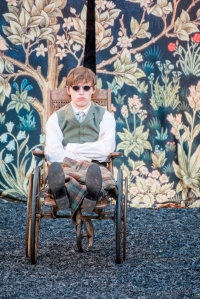
   The piece emphasises half-explored themes of prejudice within the original story, whether it concerns class, race or gender. The words of Mrs Lennox as she scolds her daughter’s “filthy native” Ayah in India, are repeated by Mary herself when she first meets her new maidservant, Martha, in Yorkshire. These obstacles are later overcome, however, as Mary goes on to befriend Martha and her animal charmer brother, Dickon. The addition into the plot of a modern-thinking, perceptive, female doctor who treats Mr Craven’s spine curvature abroad contrasts starkly against the thoroughly Victorian male doctor back at Misselthwaite Manor, whose supposed treatment of sickly, young invalid Colin Craven is laced with a sinister ulterior motive. In response to Craven’s remarks that she is a truly “remarkable woman”, she assuredly corrects him by explaining that she is, in fact, “a remarkable doctor."
DSC_5691
The Secret Garden is a fabulous adaption of a much-loved classic, that stays true to the original story’s messages of kindness and healing magic within us all, and is sure to be enjoyed by children and big children alike!
   The Grosvenor Open Air Theatre runs until 24th August, and is also currently staging Macbeth and The Comedy of Errors.

For tickets and for more information, visitwww.grosvenorparkoepnairtheatre.co.uk or call 0845 2417868


24/07/2013

THEATRE REVIEW: A MIDSUMMER NIGHT'S DREAM ~ Grosvenor Park Open Air Theatre

A dreamy way to spend a Midsummer's night


Though rain begins to fall with aptly theatrical timing, nothing can dampen the spirits of the audience members as they sit munching their picnics, eagerly awaiting Chester Perform’s production of A Midsummer Night’s Dream to commence at Grosvenor Park Open Air Theatre. It wouldn’t be a British Summer without a shower or two , but luckily the clouds quickly pass to make way for this intriguing interpretation of a timeless work.

In a performance that reiterates the notion of reflection and contrast, we soon learn that the actors playing mortal rulers Hippolyta and Theseus are also cast as the flighty rulers of Faery, Titania and Oberon.  Clever use of actor twins Danielle and Nichole Bird means that Puck, the nimble trickster sprite, appears to zip around the earth in the twinkle of an eye, speedily rushing off stage in one direction only to zoom past again from the other seconds later. Though the two later come to be on stage at the same time, admittedly shattering the ingenious illusion, the production’s duality motif is further highlighted by the antics of the mischievous pair.
The most striking embodiment of this counterpart imagery appears when the acting troupe of simple tradesmen first depart, lifting up a giant metal ring from around the circular stone podium in the midst of the theatre - a symbolic loosening of the girdle of reality and reason - to float in ethereal mimicry of the earthbound mortal world. Only now that this strange doorway in the air is manifest, and the deliciously atmospheric full moon gleams amid the real storm clouds above, can the Fairies enter; attired like a motley gypsy band, they bring no end of mayhem and mischief in their wake, not to mention spark a veritable explosion of carnal yearning in the mortals with which they choose to toy for a night’s sport. . . With the juice of an intoxicating flower smeared about their eyes, we see rival suitors Lysander and Demetrius snarling and writhing like hounds as they hump the earth (as well as the leg of a very bewildered Helena) in a burst of pure animalistic passion.
 The result is a riotous fight scene with a rainbow spectrum of powder paint bombs blooming in the air with Fairies devilishly providing the unwitting humans with ammunition. Whilst hilarious, it has to be said that the dismayed sense of sisterly betrayal Shakespeare penned in the quarrel between Helena and Hermia is somewhat disappointingly drowned out in the uproar.
Nevertheless, the combined efforts of director Alex Clifton and choreographer Imogen Knight ensure that the Bard’s elegant and ornate Elizabethan words are colourfully expressed in a manner that is enormously entertaining to all the family.  Spectacle is very much the order of the day and we are given it in abundance: lords and ladies chant in candlelit procession; Fairies crow a rustic lullaby on folk instruments; the humble workemens' troupe performs its play-within-a-play to the newly-weds (now seated, like the audience, with drink and picnic in hand) along with a sprightly Morris dance, at both of which the audience continually roar with laughter, clapping and stomping away to the music.
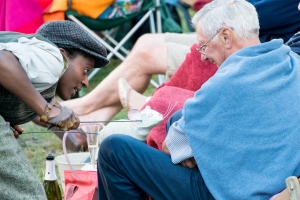
Actors and audience alike delight in the frequent interaction with the gathered onlookers: lordly Oberon smears the charmed flower’s aphrodisiacal juice upon the noses of an elderly couple and cheekily wishes them a good night, whilst Bottom runs about as an ass with a Fairy entourage to steal a swig of prosecco or a mouthful of grapes from stunned picnickers, and lovelorn Helena chases her would-be sweetheart through the seated crowd to take a perilous dive off the terrace above.
Shakespeare’s work continues to speak to us through the ages of the unifying and transcendental power of love whilst convention is well and truly turned on its head, and this production remains faithful to these themes whilst instilling it with a fresh and original vibrancy.


19/07/2013

THEATRE REVIEW:CYRANO DE BERGERAC ~ Grosvenor Park Open Air Threatre, July 2013

Cyrano’s success as plain as the nose on his face


The Grosvenor Park Open Air Theatre has been delighting its audiences since its launch back in 2010 by champions of Cestrian culture Chester Performs. With nine critically acclaimed productions under its belt, the open air group goes to show it only improves with age as it wows us with this year’s outstanding productions of Othello,A Midsummer Night’s Dream and Cyrano de Bergerac.
    Edmund Rostund’s renowned play follows the tale of the nobleman Cyrano, chief Cadet in the French army’s Gascon company and wordsmith extraordinaire who can melt or enflame a heart by merely opening his mouth; he has nevertheless afflicted by an overly large nose. Our hero’s cousin and secret love, the fair Roxanne, is smitten by a handsome but inarticulate new Cadet and so Cyrano embarks on the heart-breaking quest to woo the lady on his friend’s behalf.
      Having previously written for the Grosvenor Park theatre, Glyn Maxwell makes a triumphant return with this striking, new adaption directed by Lucy Pitman-Wallace; no mean feat, with the writer having to tackle a the original work's forty threenamed parts – as well as a host of soldiers, courtiers, poets and more – all inhabiting five utterly different sets, from a baker’s shop to a war-zone, and somehow transform it all into twelve actors performing in one single outdoor space.

   Shuffling the play’s chronology, the nun’s from Act V are ingeniously brought forward to the opening (thus seamlessly framing the plot) as they begin to recount the tale of the soldier-bard from some fifteen years before. Before long, we see the nun’s take on the roles of many of those in the story, suddenly arming themselves and donning plumed hats as they riotously merge with other figures that enter now from all directions in sumptuous period costume, along with the titular protagonist himself played by Edward Harrison. The actor's portrayal of de Bergerac and his legendary panache is superb: sporting a stylised nose cleverly crafted from parchment covered in poetry, Harrison is charismatic, witty and collected with the most perfect theatrical timing.


   Indeed, the whole cast ought to be praised for their stellar performances, not least the nuns with their ever-changing roles; perhaps most notable amongst them being the talented twins Danielle and Nichole Bird. Many of the cast also had a chance to showcase their musical accomplishments: during a rousing and rustic Gascon anthem played to lighten the lift hearts before battle; Katherine Toy’s pleasing accordion interludes between and even during scenes; the emotive and truly haunting a capella chanting of what seemed to be a Latin mass during the dual between Cyrano and one hundred men, skilfully choreographed in slow motion by Sue Nash.

   With actors scaling the seating and livelily interacting with audience members happily picnicking mere feet away, Cyrano de Bergerac is an outstanding performance – at times brimming with humour, at others poignant and heart-rending – that is sure to thrill this summer’s theatre goers.

 For more information on this or any other performance, visit: http://www.grosvenorparkopenairtheatre.co.uk/


10/05/2013

THEATRE REVIEW: MATTHEW BOURNE'S SLEEPING BEAUTY ~ Liverpool Empire, 4th May

Matthew Bourne’s Sleeping Beauty Hears Bumps in the Night

The commencement of award-winning choreographer Matthew Bourne’s latest production in 2012 marked the 25th anniversary of his acclaimed company, and is touring the UK until mid-May when it will continue with a host of international performances. Sleeping Beauty evokes much of the darkness of Charles Perrault’s original fairy tale whilst turning the plot on its head in a bold new retelling of this timeless story of malice, unconquerable love, and hope.  
            In this reimagined version, the King and Queen, desperate for a child of their own, invoke the aid of Carabosse the Evil Fairy who, offended by the lack of royal gratitude for granting their wish, curses the newborn baby, Princess Aurora, to prick her finger upon a rose and die when she comes of age in her twenty first year. The Good Fairy, Count Lilac, though unable to lift the evil curse, transforms it into one hundred years’ enchanted sleep instead. After his mother’s death, the Evil Fairy’s son Caradoc arrives at the Princess’s birthday celebrations and leads the doomed Aurora to her fate. When her secret true love, Leo (alas no prince, but rather the humble gardener’s boy) unintentionally eludes the Good Fairy’s slumberous enchantment over the castle, he must take drastic action and overcome the mortal implications of the long years that lie before him in order to awaken the sleeping princess, battle against Caradoc and his deadly, amorous intentions, and be reunited with his love once more.
Act one begins in 1890 (the year in which Tchaikovsky’s production was actually first performed), act two springs us forward to 1911, and act three then leaps resoundingly into the modern day when Aurora’s bewitched sleep finally ends. Lez Brotherstone, Liverpool-born designer, has created beautiful sets for all these periods and everything in-between. His designs are at the same time delightfully simplistic and gorgeously lavish: The Victorian interior of the castle is dominated by  a wide window through which the full-moon peers, only to be masked by a gigantic velvet drape that splits the stage in half;  the topiaries and rolling expanse of grass in the castle grounds of 1911 create the illusion of a bright and airy Edwardian summer’s day; A strange land of fog and lantern-covered trees acts as the dreamscape of the enchanted sleepers; the elegant red and black 21st century night club is the stylish haunt of fairies in the present day.  A cleverly designed set of double conveyor belts towards the back of the stage enables the cast to drift ethereally about all these sets, allowing for some incredible choreography.  
   In terms of music, it must be said that the overall impact of the whole piece is weakened to an extent by the lack of a live orchestra, despite the very admirable use of Tchaikovsky’s score by music producer Terry Davies sound designer Paul Groothuis. The thrilling atmosphere an orchestra can generate as it tunes up moments before curtain is something a sound system will simply never be able to match.
The cast performances, however, are truly unimpeachable. Huge credit must be given to dancer Hannah Vassallo, whose accomplished portrayal of the feisty princess is fantastically animated, in spite of the fact she spends a large portion of the performance’s latter half dancing as though asleep as well as blindfolded.
Dominic North’s acting and dancing skills are excellent, there’s no doubt, but even they can do little to inflate the somewhat regretably lacklustre quality of Bourne’s hero Leo, who tends to remain as two-dimensional as the archetypal figures of Tchaikovsky’s original masterpiece. Indeed, the relationship between the gardener’s boy and Princess Aurora somehow remains disappointingly hollow throughout. Far more convincing is the dark web of emotions belonging to the sinister yet charismatic antagonist Caradoc, whose disdain for Aurora quickly mingles with desire as he dances a seductively menacing pas de deux with her and later caresses her lifeless body in a memorable and skilful dance sequence.
Tom Jackson Greaves, who plays Caradoc, also shines in his alternate role as the Evil Fairy Carabosse, whose brief, regal and menacing presence is keenly felt, not least during the especially haunting moment she conjures up a ghostly vision of the future princess, who dances on stage costumed so as to appear faceless as she eerily prophecies the details of her future curse.
Not without humour, the second half of the performance opens in the year 2011 with a group of true-to-life modern teens vainly posing for pictures outside the briar-ridden gates of the castle, and the beanie-covered head of lovelorn Leo pops out of a tent with his endearingly mini set of wings revealed. Earlier in the performance, masterful puppetry very nearly steals the show as it has the mischievous baby Aurora scrambling about the stage, scaling curtains and sitting up inquisitively in her cot, all whilst interacting perfectly with the cast members.

Bourne’s fairies (three of either sex) are decked in glittering aristocratic finery trimmed with multi-coloured rags to hint at their wild, otherworldliness; each sports an unobtrusive set of delicate wings and a black mask-like strip of shadow across the eyes. Bourne instils these mysterious creatures with a figurative and literal bite: in a vampiric twist, good fairy Count Lilac, played by the talented Christopher Marney, takes heartbroken protagonist Leo (who has accidentally alluded the sleeping charm the fairy earlier placed across the castle) in his arms and sinks his teeth into his neck, granting him immortality and the means to await the awakening of his beloved in one hundred years’ time, reiterating the production’s subtitle: ‘A Gothic Romance’.
Though it is not without faults, Matthew Bourne’s is a strong and visually stunning adaption in which his unique style of choreography flows seamlessly together; his vast imagination takes root and blossoms in order to fill us with child-like wonder, like the storyteller extraordinaire that he is.

For more details on the show, visit:


(Photos sourced from the offical New Adventures website)


10/03/2013

THEATRE: EQUUS, 2013 ~ Review


Equus proves to be a one-horse race

Tip Top Productions’ five-night performance (5th-9th March, 2013) of Peter Shaffer’s classic play Equus, led by innovative guest director John Young at the Forum Theatre Chester,  goes to show that though Shaffer claimed ‘life is only comprehensible through a thousand local gods’, all you actually seem to need is a handful of local talent.

          The play focuses on psychiatrist Martin Dysart as he deals with Alan Strang, a reserved seventeen year-old who has committed a horrible and seemingly senseless act of violence against several horses. As treatment progresses and Alan’s motives and desires unfold, Dysart starts to find himself questioning his own inhibitions…

The production opens with a silent, bare-chested figure slowly entering into view to place nothing but a mask upon his head in order to portray the fundamental essence of a horse. This, in many ways, epitomises the nature of Young’s interpretation of the play as a whole: stripped back to its raw and most potent elements. Subtly reminiscent of the archetypal masks of Greek Theatre, the abstract simplicity of the headgear’s design echoes the drawing style of Jean Cocteau, renowned for his obsession with the myths of Classical Greece - myths that, like Shaffer’s play, lay bare the truths of the human psyche.

The set does much to channel the themes of the play: a raised wooden dais to evoke the idea of a stable and reiterate the significance and authority of Shaffer’s curious horse god, Equus, the embodiment of worship, forever stamping his hoof to make himself known; an arch framed on either side by bars, through which audience and actors alike enter and exit the venue, to evoke horse stalls and allude to the playwright’s notions of freedom versus imprisonment through society’s accepted norms.

Versatile and carefully employed lighting brings great depth to the piece. At one moment, it offers a subdued fragility to the sex scene (and ensures the nakedness of the actors is tastefully done, without taking away from the strikingness of the image); the next, it imbues the confrontation between Alan and Equus with real menace as a hellish red glare cast up from below merges with smoke that rises suddenly to circle about the actors.

Local thoroughbreds: the cast of Tip Top Productions' Equus
                Though amateur, the actors’ performances remained mostly strong and poignant throughout, and the choreography was always captivating and effective, particularly with its clever use of different levels and heights to tackle the venue’s limited space and ensure the piece is visually stimulating even when the actors aren’t moving.

A bold and thoroughly thought-provoking production, it promises great things from director Young in the near future.

Related Posts Plugin for WordPress, Blogger...