' I think, that if I touched the earth,
It would crumble;
It is so sad and beautiful,
So tremulously like a dream.'


26/04/2013

ARTICLE: GRATEFUL TO GATSBY ~ Jazz Age Revival in the Modern Day


F. Scott Fitzgerald’s novel The Great Gatsby is unequivocally one of the best literary works of the twentieth century. ‘In my younger and more vulnerable years’ (to quote the opening lines of the novel’s realistically flawed narrator, Nick Carraway), I was introduced to the text at school and was instantly smitten.

         It follows the tale of one enigmatic man’s unquenchable sense of hope as he tirelessly strives to win back a love that slipped through his fingers years before, all amid the corruption and decadence of Jazz Age New York. Though evocative of its era, it is a timeless story that resonates as strongly today as it did then, and with gorgeous prose and short, pacey chapters, The Great Gatsby is a must-read you’ll devour in no time at all and be left wanting more.

      As the excitement grows for the release of Baz Luhrmann’s latest bold new film adaption starring Carey Mulligan and Leonardo Dicaprio, it seems that Gatsby mania has taken hold.

Francis Cugat’s poignant artwork for the original edition of The Great Gatsby (right) so impressed F. Scott Fitzgerald that he decided to reference it in the book itself: ‘I had no girl whose disembodied face floated along the dark cornices and blinding signs’. As well as new editions of this cover, many others are now being released. In particular, Penguin has created a sumptuous new set of Fitzgerald’s stories with beautiful, shimmering Art Deco covers (Below).


Perhaps most influenced of all by the renewed interest in all things 20s is, however, the fashion world, as seen in Sue Wong’s new collection of elegant evening gowns dripping with glittering jewels and embroidered beading. And it’s no small wonder, with Prada having designed the dazzling array of costumes for the film’s actresses, mixing vintage styles with some of its more recent lines to create some strikingly beautiful and daring new pieces (below). 


Four sketches released by Prada for their The Great Gatsby costume designs

Along with hit series such as Mad Men and Boardwalk Empire, The Great Gatsby is also prompting men to look to the iconic styles of the past in favour of sleek tailoring, tie pins and luxurious fabrics. Being an advocate of classic men’s attire, I couldn’t be more thrilled.

In a bid to remain faithful to the look of the period, Catherine Martin, the film’s Academy Awarding-winning Production Designer, approached Brooks Brothers (the clothing company that the author Fitzgerald himself used) to design the clothes for the film’s leading actors as well as all the male extras. To tie in with the film’s release, Brooks Brothers have released a collection based on the garments used in the film, even including their trademark straw boater hats (see below).

Brooks Brothers new Gatsby collection based on the garments they created for Luhrmann's new film.


          Fitzgerald was also a patron of iconic jewellers Tiffany & Co. with whom Martin also collaborated for the film. Tiffany created signature pieces, such as Gatsby’s daisy-themed signet ring (below), as  well as allowed costume designers access to their extensive archives in order to recreate jewellery contemporary to the period,  like the exquisite tiara band (below) sported by actress Carey Mulligan at one of Gatsby’s extravagant parties. What’s more, the jewellers has released its Jazz Age Glamour Collection, decorating the flagship Fifth Avenue store with window displays inspired by the film (below). To show their appreciation for the original book, Tiffany has even granted Orion Books permission to use a design from their archives to create a new book cover.


Some of Tiffany's deco Jazz Age Glamour Collection window displays, New York


               The film will be in cinemas on 10th May, and I not only hope it is able to live up to the hype surrounding it, but that it also does justice to Fitzgerald’s masterpiece. If nothing else, Luhrmann’s adaption has made us appreciate once more all the beautiful artistic triumphs of a bygone era. I leave you with the words of Jay Gatsby himself: “‘Can’t repeat the past?’ he cried incredulously. ‘Why of course you can!’”


24/04/2013

MUSIC: SCOTT MATTHEWS ~ Chester Gig REVIEW

Scott Matthews Performance,23/04/13:
What the Night Delivered


(Above image courtesy of www.glee.co.uk)
This is the third time I have been irrestibly drawn to watch the Ivor Novello Award-winning acoustic folk artist perform live now, and I would do so a thousand times more for such an incredible talent.  Scott’s desperately beautiful songs are nothing less than bewitching: his fingers dance effortlessly over the strings and a voice floats suddenly toward you as if from a dream, holding the thronged audience of Telford’s Warehouse, Chester, in hushed awe.
What I find most striking about Scott’s performances is that if you were to close your eyes, you could be forgiven for thinking you were actually listening to hymns being sung to you by some unearthly cello and not a man, so distinctly like the sound of swelling strings is the tone of his voice.
 He is taking this tour, he explains, to get the songs out of his system and learn their personal meanings before recording them in the coming months for what will be his fourth album after Passing Stranger, Elsewhere, and What the Night Delivers.

           
Afterwards, he seems genuinely humbled and grateful that people appreciate his work, and is eager to make to time to chat warmly with his fans, without rushing.
Scott’s talent puts to shame the likes of artists such as Damien Rice and recent flavour of the month Ed Sheeran, and though he has a large following and is very much a respected “musician’s musician”, quite why his household acclaim isn’t greater than it is at present is utterly baffling.  Regardless, Scott’s fourth album will hopefully be released at some point later this year, and I simply cannot wait.

To listen to Scott Matthews:
https://soundcloud.com/#scott-matthews-music

To find out more about Scott and his upcoming tour dates:
http://scottmatthewsmusic.co.uk/


24/03/2013

CULTURE: Rogues’ Galleries ~ Storyville

Rogues’ Galleries Storyville: Exploring the art in life’s artefacts
Whilst wandering along Chester’s high street and historic Rows, one passes an alarming and ever-growing number of vacant premises, despite its long-time renown as a ‘shopping city.’ In its on-going efforts to revive the areas failing cultural aspects, local arts producers Chester Performs recently commissioned The Rogues’ Galleries, a whole host of art installations, workshops and projects to breathe life into said empty sites and turn the notion of shopping on its head.

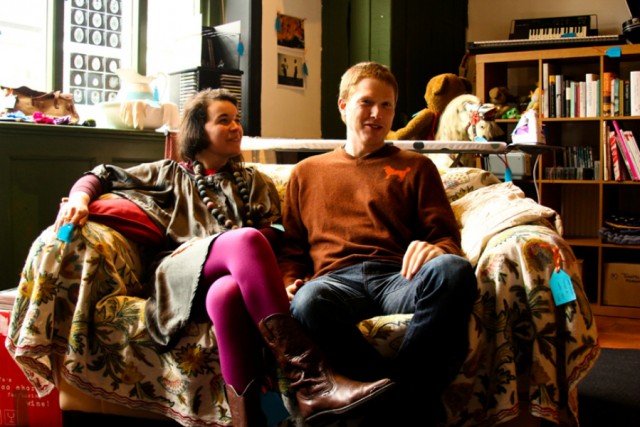
                Two such creative rogues, collaborative performance artists Katherina Radeva and Alister Lownie, have decided to set up their living room on the upper floor of a venue on Watergate Row in a piece they have named Storyville. Visitors are encouraged to come and peruse the motley collection of a lifetime’s bric-a-brac: ribbons and buttons, an ironing board, love letters, paintings, theatre props, boots, books, keys, clothes… And amid it all lays a couch, on which the duo invite you to sit for a cup of tea and a natter. They are so warm and charming that their infectious chattiness and contemplative air soon have you sharing, and reflecting on, snapshots of your own life’s history.
During my time there, I found myself discussing the surprising violence of water polo one moment and examining the ghostly images from a brain scan the next. Other visitors came and went, and I found it such a refreshing and novel experience to be able to chat with perfect strangers as they shared their own stories or showed off the spoils of a day’s shopping.
Katherina Radeva and Alister Lownie sit amid their relocated belongings at
 Storyville, their most recent artistic endeavour.

             What makes the whole thing even more fascinating is that every item in the room is for sale. The fact that that the performers are sacrificing their personal belongings and keepsakes highlights the whole purpose of the installation: to have us, and indeed themselves, question how and why we apply value to things; not merely monetarily, but emotionally. The significance we apply to an object, the moment in time it encapsulates, how the look or touch of something makes us feel, how we value the lives and experiences of others and ourselves. Kat and Alistair were also particularly keen to find out what the future has in store for each once cherished item: who is it for? How will it be used? What will it mean to the individual?
           For my own part, I was drawn to the intriguing miniature of a woman made of wire and painted plaster that I discovered whilst rummaging through Kat’s sewing box. She seemed delighted that I had found it and carried on digging around until she had produced several other such figures. She revealed to me how she had once designed and made the costumes/set for a dance piece in London and that these had been the 1:50 ratio scale models she had used in the process. The naïve charm and stylised form of each little figure along with the memories and pride that each contained won my heart and I bought them on the spot.
           And what will their future hold? They’ve got pride of place on my bookshelf to bring a smile to my face and remind me of an enjoyable and unexpected hour I once spent in the company of two delightful people whose humble art piece made such a powerful and lasting impression on me.


Far Left/tight: The dancers of theatrical dance piece Daffodils (2005, stood in Radeva's costume creations.
Centre: The tiny figurines used in the design process for the same performance
 Katherina Radeva and Alister Lownie of Two Destination Language create performance works which focus on identity and community. Their work includes theatre shows, interactive installations, one-on-one works and fun participatory projects. Their work has been presented in venues across the UK and internationally. http://www.twodestinationlanguage.com/
For more information on the Rogues' Galleries, visit http://www.roguesgalleries.co.uk/

10/03/2013

THEATRE: EQUUS, 2013 ~ Review


Equus proves to be a one-horse race

Tip Top Productions’ five-night performance (5th-9th March, 2013) of Peter Shaffer’s classic play Equus, led by innovative guest director John Young at the Forum Theatre Chester,  goes to show that though Shaffer claimed ‘life is only comprehensible through a thousand local gods’, all you actually seem to need is a handful of local talent.

          The play focuses on psychiatrist Martin Dysart as he deals with Alan Strang, a reserved seventeen year-old who has committed a horrible and seemingly senseless act of violence against several horses. As treatment progresses and Alan’s motives and desires unfold, Dysart starts to find himself questioning his own inhibitions…

The production opens with a silent, bare-chested figure slowly entering into view to place nothing but a mask upon his head in order to portray the fundamental essence of a horse. This, in many ways, epitomises the nature of Young’s interpretation of the play as a whole: stripped back to its raw and most potent elements. Subtly reminiscent of the archetypal masks of Greek Theatre, the abstract simplicity of the headgear’s design echoes the drawing style of Jean Cocteau, renowned for his obsession with the myths of Classical Greece - myths that, like Shaffer’s play, lay bare the truths of the human psyche.

The set does much to channel the themes of the play: a raised wooden dais to evoke the idea of a stable and reiterate the significance and authority of Shaffer’s curious horse god, Equus, the embodiment of worship, forever stamping his hoof to make himself known; an arch framed on either side by bars, through which audience and actors alike enter and exit the venue, to evoke horse stalls and allude to the playwright’s notions of freedom versus imprisonment through society’s accepted norms.

Versatile and carefully employed lighting brings great depth to the piece. At one moment, it offers a subdued fragility to the sex scene (and ensures the nakedness of the actors is tastefully done, without taking away from the strikingness of the image); the next, it imbues the confrontation between Alan and Equus with real menace as a hellish red glare cast up from below merges with smoke that rises suddenly to circle about the actors.

Local thoroughbreds: the cast of Tip Top Productions' Equus
                Though amateur, the actors’ performances remained mostly strong and poignant throughout, and the choreography was always captivating and effective, particularly with its clever use of different levels and heights to tackle the venue’s limited space and ensure the piece is visually stimulating even when the actors aren’t moving.

A bold and thoroughly thought-provoking production, it promises great things from director Young in the near future.

25/01/2013

Review: PERFUME: THE STORY OF A MURDERER ~ From Book to Film

'[...]his gifts and his sole ambition were restricted to a domain that leaves no traces in history: to the fleeting realm of scent.'  

Süskind's novel is one you'll be glad you stuck your nose into.   

   Written in 1985, Perfume: The Story of a Murderer (or Das Parfum as it appears in its original German) tells the story of 18th century man gifted from birth with the finest nose in the world. With it, he can detect, and distinguish between, every smell under the sun. 

   Relishing in the thousands of odours he encounters and stores up like ghostly memories in his black heart, he soon becomes obsessed with creating a perfume like no other on earth: a perfume made up of the collected fragrances of beautiful, young woman.  Its crowning glory will be the most intoxicating and elusive female scent he has ever encountered; and he will stop at nothing to possess it...

   Split into lots of short chapters and with eloquent and very pretty prose that are satisfyingly easy to read,  it is the ideal book for dipping in and out of; though, perhaps because of this, you may well find yourself lured into sniffing out "just one more chapter..." after another. It is a very pensive novel, and challenges our notions of beauty, self, and social order, yet all in a manner that refuses to be heavy going or patronising to the reader.


   Due to the fact that much of the book's most poignant moments involve the experiencing of certain aromas and the internal reflections and revelations they incur, it is certainly a difficult book to adapt onto screen. However, despite a certain necessary trimming-down of time periods, Tom Tywker's 2006 film adaption (see trailer above) is largely successful in its portrayal of such a seemingly impossible novel to film; all thanks to a clever use of 'blooming' light effects, camera shots and angles, and (the usual favourite of mine) a superb soundtrack (see right) which manages to beautifully imitate the detection and elusiveness of scents and the veritable ecstasy Grenouille feels in encountering them (best identified in the tracks  'Streets of Paris' (1:51) and 'Meeting Laura' (27:09)).

    Without wishing to ruin the end of either the book or film, the director manages to portray, in a very artistic and tasteful manner, an especially difficult scene from the end of the story (to those of you in the know I need merely say the 'town square' scene) which could potentially have seemed vulgar and ridiculous. It is a film I would very much recommend.

Rachel Hurd-Wood as the intoxicating Laura Richis (Left) and Ben Wishaw as Jean-Baptiste Grenouille (Right), murderous Perfumer with an extraordinary gift, in Perfume: The Story of  Murderer (2006).
    Without any further gilding the lily, it remains only for me to say that Perfume: The Story of  a Murderer is an intriguing and satisfying book that brings in to question a whole host of ideas of identity and of the finite nature of life.

Rating: ★★★

Softback book:
http://www.amazon.co.uk/Perfume-Story-Murderer-Patrick-Suskind/dp/0141041153
Film adaption:
http://www.amazon.co.uk/Perfume-Story-Murderer-DVD/dp/B000MTF09A

   What're you thoughts on Süskind's novel? Does the film adaption live up/surpass to your expectations? Let me know your thoughts!

21/11/2012

Film Score: Dario Marianelli ~ Jane Eyre (2010)

Eyres and Graces: Marianelli's Masterpiece

I've always had a thing for a good film score. You can have the most well directed film you like, but if its score is lacklustre, the whole thing suffers. Vice versa, a beautiful soundtrack can do much for a film that is itself relatively mediocre. 
    Call me mad, but I can happily sit in my room and listen to some of my favourite film score composers for hours on end. One of my absolute favourites has to be the Italian genius that is Dario Marianelli. He's written original scores for a whole host of films; some of his most recent and no doubt most famous works being Pride and Prejudice (Oscar-nominated for Best Achievement in Music Written for Motion Pictures, and Original Score) and Atonement (which won an Academy Award and a Golden Globe for Best Original Score), both of which truly are amazing.

   An OST (original soundtrack) of Marianelli's which, to my horror, seems to have slipped through the net however, is Jane Eyre (2010), the most recent adaption of Charlotte Brontë's classic. I find it outrageous how overlooked it seems to have been, when, in reality, it is, in my opinion, one of his finest compositions of all. It features the musical talents of Classical Brit Award-winning violinist Jack Liebeck, whose doleful and rustic fiddle pieces evoke so much of the orphaned, governess protagonist's pent up passions; her sorrow and ecstasy alike. I find, too, the repeated use of a riff that one presumes to be an eerie distortion of a melody to some once happy love song from Mr Rochester's past (he is briefly seen playing it on an out of tune piano as he dwells on dark thoughts) incredibly tantalizing and ingenious. It can be heard in the opening of track one (below), 'Wandering Jane':  


   The following is a medley of several other tracks from the OST. Particular favourites of mine featured in it are 'Awaken' (opening)  and the sinister and heart-rending 'An Insuperable Impediment' (3:49).


   It is an utterly  haunting and exquisite film score. http://www.amazon.co.uk/Jane-Original-Motion-Picture-Soundtrack/dp/B004KD5TQS


   What are your impressions of the Jane Eyre score and/or Dario Marianelli's other scores ?
I'd love to hear your thoughts!
   

17/10/2012

Richard Dadd: Of Paint and Madness

'nought as nothing it explains / And nothing from nothing nothing gains.' 

William Michael Rossetti once described the painter Richard Dadd as 'the ill-starred painter'. With his story being one of insanity, evil spirits, murder and fairies,  this epithet was certainly well-chosen. 

  
Things, however, did not begin sadly for Dadd: born in 1817, he was a rising star of the art world, admitted into the Royal Academy at only 20, and member of a circle of aspiring young, Victorian painters known as The Clique.

  
Yet, at twenty five, his life took a dramatic turn for the worst when, in the summer of 1842, he accompanied a patron, Sir Thomas Phillips on his Grand Tour of Europe and the Middle East. The pair were having a marvellous trip until their arrival in Egypt, during which time Dadd began to act peculiarly, something which Phillips put down to a case of sun-stroke. However, by the time they had returned to Italy, Dadd had become violent towards his travelling companion and was convinced he was being followed. What's more, in Rome, he had an incredible urge to assassinate the pope during a public appearance.

       On his return to England, Dadd became convinced that he was being plagued by spirits and ancient deities, most prominently that of the Egyptian god of the Underworld, Osiris, with whom he was obsessed and who constantly ordered him about. What was then labelled simply as 'insanity' we know now to most likely have been severe schizophrenia.
   On the night of August 28, 1843, Robert Dadd, the artist's father, accompanied his ailing son on a evening walk in a park in Kent. The next day, the bloody corpse of Robert was found near a pool. Richard had used a razor to clumsily slit his father's throat, stabbed him several times in the chest, then had fled immediately to Calais and onwards to Paris. He was later arrested there after attacking a fellow traveller with his razor, and was brought back to England, where he was incarcerated in London's infamous Bedlam, and spent the rest of his life in insane asylums.
Whilst the picture I have painted is one of a madman, the pictures he painted, especially during his time at Bedlam were, irregardless, extraordinary. Indeed it seems that, for Dadd, painting was a calming release, and his jailers appear to have encouraged it. He not only painted canvases, but was allowed to paint murals on the prison's walls, and even design and decorate sets for its theatre.
The Fairy Feller's Master-Stroke (1855-64)
   
   His paintings during this time, though portraying supernatural and arcane scenes, were nevertheless painstakingly and cool-headedly executed. No doubt his most famous work is The Fairy Feller's Master Stroke on which he worked for roughly nine years, and about which he wrote and long and rambling descriptive poem (a line of which graces the heading above). The scene is viewed through long blades of grass and shows a tiny glade filled with all manner of fairy folk who are anxiously waiting for their King to signal a wood-feller at the centre of the piece with his axe held aloft to cleave an acorn in two for the carriage of Queen Mab.

   I was lucky enough to see this painting on display at Tate Liverpool earlier this year, and I can say without hesitation that no photograph you will find can do the original work justice. Each swirling blade of grass obscuring your view, each daisy,  tiny hand and delicate wing is astoundingly detailed and has the most incredible texturing one will ever see. One almost believes one could pick one of the tiny buds in your hand, they are so real. Every inch simply captivates the eye. Unsurprisingly, the piece has gone on to inspire writers like Angela Carter, Terry Pratchett and Neil Gaiman, and was even the basis for a song by Queen.
   Dadd's life was dogged by sadness, yet his evocative and beautiful work is a lasting testimony to the man and the artist behind the misery.
For more on Dadd's life and art, see this intriguing article from The Guardian:


09/10/2012

Film Review: Anna Karenina (2012)

A moving and bold adaption that is breath-taking in its theatricality


The respective talents of director Joe wright and screenwriter Tom Stoppard that have united to create this latest adaption of Leo Tolstoy’s classic novel Anna Karenina, deliver a fresh and vibrant addition to the rather stagnant realm of the period drama.
  The film recounts the fall from grace of Anna karenina (Keira Knightley), an aristocratic socialite who defies her husband, government offical (Jude Law) as well as the accepted social norms of 19th century Russia in her scandalous love affair with young, handsome and devilishly charming army officer Count Vronsky (Aaron Johnsnon).
Keira Knightley on set, with the clutter of
backstage at a theatre merging with the lavish
surroundings of 19th century Russian aristocracy.
  To describe this film as visually breath-taking is an understatement.
   The captivating and imaginative concept of setting the majority of the film within the confines of a 19th century  theatre blurs lavish and dream-like scenery with the very real ropes, props and cobwebs of the stage wings. The result is a deliciously stylised portrayal of the decadent final days of the Russian Empire where surge heated passions and scandals, that serves to contrast starkly with the fleeting glimpses we are given of the labouring world of the character Levin, played by Domnhall Gleeson, the film’s ‘one true soul’ according to production designer Sarah Greenwood; he is Wright’s Tolstoy counterpart who is able ‘to leave the theatrical metaphor. He gets a proper house and fields and everything.’ The perfection to detail is at once apparent, from the sumptuous costumes – noticeably Knightley’s, whose garments inspired by 1950s French couture give a subtle dash of modernity to 19th century elegance – to the perfectly choreographed and ethereal dance scenes.
   Despite Johnson coming off as a touch wooden and Keira Knightley’s occasional habit of overacting some scenes, the performances are nevertheless strong, well-played and, combined with the orchestral genius of Dario Marianelli’s superb score, incredibly moving, ensuring Wright’s creation contains a wealth of substance to match its unquestionable style.
   Anna Karenina is a successful interpretation of a notoriously difficult novel to portray on screen, a must see film that explores the boundaries between artifice and reality, happiness and duty, love and lust.
Rating: ★★★★
Runtime: 130 min. In cinemas now.
Related Posts Plugin for WordPress, Blogger...