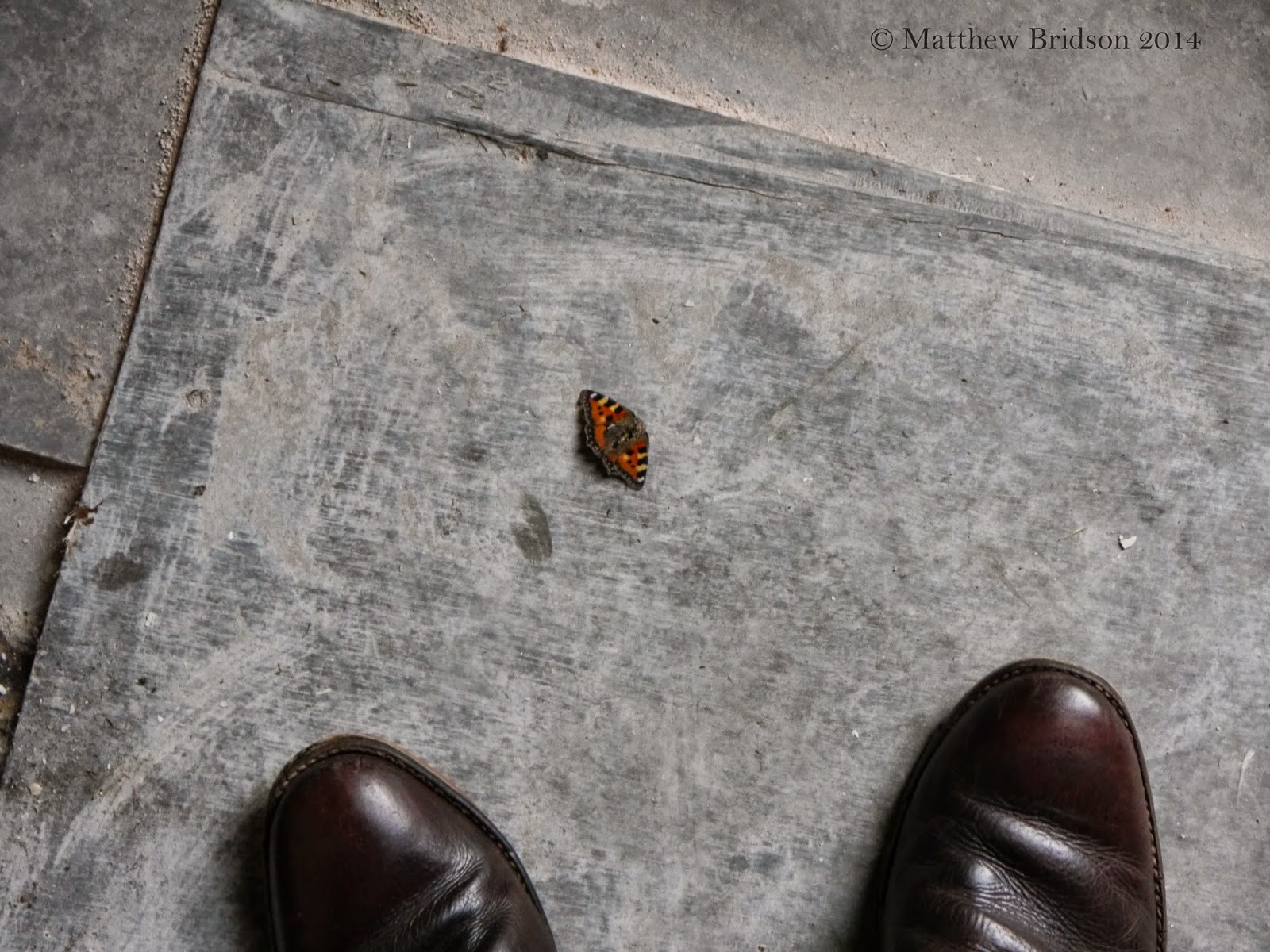
' I think, that if I touched the earth,
It would crumble;
It is so sad and beautiful,
So tremulously like a dream.'


Showing posts with label Heritage. Show all posts

20/03/2015

‘Day Became as Night’ – The Solar Eclipse in Myth and Days Gone By


Across the UK today thousands of people looked to the skies to catch a hopeful glimpse of a partial solar eclipse; the first such occurrence seen by the nation since back in 1999. And we weren’t disappointed.


Much of the cloud that had been predicted broke and onlookers were rewarded with the breath-taking and eerie site as the path of the moon’s orbit crossed between earth and the sun and sent us into temporary twilight. Those who were stuck inside and missed it needn’t worry – you only have to wait a mere 75 years to see the next one here again.

Further up the northern hemisphere in Svalbard, where hotels have been booked up specifically for this occasion since as far back as 2008, the obscuration of the sun was total, and the islands were plunged into utter darkness. 


The word ‘eclipse’ itself actually derives from the Greek ekleipein, literally meaning ‘to abandon’, since the sun seemingly appears to forsake the sky. With this in mind, it’s easy to see how ancient cultures across the globe created all manner of myths and legends as they sought to explain an event which even today – despite our scientific understanding – cannot fail but to fill us with awe and a certain vague sense of dread, as daylight is momentarily extinguished.

Though they had a great knowledge of the heavens, the Inca people of South America were surprisingly unable to predict eclipses, so when one took place they became understandably distressed. They feared that Inti, the Sun God (and second only in importance to the Creator God himself), was displeased and had hidden his life-giving light from them. Although the Inca rarely practised human sacrifice, such anxious times often demanded it, in their eyes, along with offerings of food, livestock and gold, in an attempt to appease the god.


According to Hindu belief, the sun is devoured by the demon Rahu during a solar eclipse. It is said that he once tried to drink sacred nectar that would make him immortal, but the sun and moon quickly realised his plan and alerted the god Vishnu, who lopped off the demon’s head just as he had begun to drink. Since the nectar didn’t get any further than his throat, only his head became immortal, and floated off into the sky. Ever since, he has vengefully chased the sun and moon and manages to swallow them from time to time, but they always re-emerge from his severed throat.

The ancient Chinese, on the other hand, believed that it was a dragon consuming the sun when an eclipse occurred and so would shout and bang whatever they could get their hands on to frighten off the creature.

Viking Mythology predicted that Ragnarök (the apocalypse) would be brought about when two monstrous wolves devoured the sun and moon, so a solar eclipse undoubtedly had them worrying that the end of the world had arrived.

Whatever was thought to be their cause throughout the ages, eclipses have almost always been seen as ill omens. Various early historical accounts tell of one total solar eclipse that took place during a 6th century battle in the long drawn out between the Lydians and Medes. As fighting commenced, ‘day was suddenly turned into night’; both armies ceased their combat out of fear and became anxious to agree a treaty of peace.


Supernatural association with the phenomenon still exists even to this day. Some people maintain the romantic notion that certain significant cosmic events appear to be inexplicably connected to the life of King Richard III, whose body is to be reinterred in Leicester Cathedral this weekend after being discovered buried beneath what is now a car park in the city. On the day of his wife’s death in March 1485, a great eclipse of the sun took place; several days after Richard’s defeat at the Battle of Bosworth that same year, a partial lunar eclipse or “Blood Moon” would have shone down as his corpse lay on humiliating display, naked and bound, beneath the arches of a nearby church. Numerous fervent Ricardians see this latest solar eclipse, only a few days before his reburial, as the final celestial sign to coincide with important events relating to the life of the last Plantagenet king.

As well as the solar eclipse, today also marks the Spring Equinox, exactly halfway between the longest and shortest days of the year, when the Earth’s axis is perpendicular to the sun’s rays, and day and night are of equal length. What’s more, the moon will be orbiting at its closest point to our planet, appearing much larger than normal as what’s known as a Super Moon. 

The rare coinciding of these three celestial events could be seen by the superstitious as a portentous sign of change, of new beginnings. Whatever the case, however, it is a day to make each one of us pause and be reminded of the many wonders of the universe we live in.


(Image 1 © Sarah Deboe 2015; Image 2; Image 3&4 taken from De aetatibus mundi imagines by Francisco de Holande; Image 5 Das Wunderzeichenbuch (The Book of Miracles), 1552. )


19/03/2015

'Mes photos de Kairouan' - beautiful 1950s snapshots of a timeless holy city


Rummaging around for unusual ephemera in a charity shop recently, I came across a handful of mid-twentieth century travel photo sets, some colourised, some in black and white, each bundled up in its own eye-catching slip case envelope. Among them was a set entitled Mes photos de Kairouan containing around a dozen beautiful and fascinating images of the historic Tunisian city in question, taken during the 1950s by a Parisian photography company.  I was captivated and needed to find out more! 

The historic city of Kairouan is one of the holiest cities in Islam and its ‘old city’ quarter, a labyrinth of winding streets and minarets, is home to the masterpiece of Maghreban architecture, the Great Mosque, as well as the Mosque of the Three Doors, which is the most ancient known example of a sculpted Muslim art façade still in existence. From the 9th to the 11th century, when the city was in its prime, The Great Mosque was a place of both religion and knowledge, a key, bustling centre of learning filled with scholars from across the Arab and Islamic world exploring spiritual thought and the sciences. In the 1980s, Kairouan’s rich architectural heritage resulted in it being deservedly (and thankfully) inscribed as a UNESCO World Heritage Centre.


The photographs I found are snapshots of a city that has changed little neither before nor since they were taken; this timelessness is silently preserved in their striking black and white.  One image in particular is especially haunting. In the deserted, sunlit courtyard of the Great Mosque, stand two isolated figures: one, dressed all in black, is stood in the angular shadow of a building; the other, all in white and cloaked, is stood apart, nearer to the camera, in a somehow paler wall of shade. Both face us head on, yet both faces are obscured.  The resulting image is unequivocally eerie. Its human subjects were probably unintentional and almost certainly unwanted, but they nevertheless help create an evocative piece of art.

So, be always on the lookout for those small, easily overlooked mementos of the past – you never know what you’ll discover.

16/11/2014

Ghosts and Grandeur: Exploring the Halls and History of a Liverpool Architectural Gem

The stunning Victorian Gothic Revival masterpiece that is the former Liverpool Seamen's Orphanage stands in stark contrast to the pleasant, sunlit lake at Newsham Park, darkly brooding in silence as the ducks are fed. Built in 1874, it was to house the children of Liverpool's sailors, who often died at sea or were unable to care for the young members of their families.  

My family and I learned last year that my great-great-grandmother spent time in the Orphanage as a little girl and, in a cyclical twist of fate, was to pass away there as an old woman when it later became a psychiatric hospital in the twentieth century. That said, the building holds a special fascination for me, but has been under lock and key since it was left deserted in the early nineties. So, when I learned that its doors were to be opened to the public to showcase student artwork for the first Liverpool Art Festival, I leapt at the chance to explore and photograph it's mysterious interior. 

Supposedly haunted by the ghosts of its former students and mental patients, to wander the corridors of the  Seamen's Orphanage is a chilling experience to say the least. Many of its rooms still contain medical equipment and other unnerving relics of its past, and you would be easily forgiven for thinking you'd somehow walked onto the set of the hit TV show, American Horror Story: Asylum. This place is no work of fiction, however, and the forgotten stories of untold sadness and insanity that must have took place here are all too real. 

While the faded glory of the place is incredibly compelling, such a beautiful building cannot be left to fall into dilapidation for the sake of the occasional photographer looking for an evocative shot or two. It's encouraging to hear, then, that the current owners, a development agency, are considering plans to transform the majestic space so that it can play host to a multitude of cultural events. I hope that such a change will dispel some of the oppressive shadows of its former uses that still linger within, and let us celebrate and preserve this unique piece of Liverpool's architectural heritage. 


22/07/2013

CULTURE PRESERVATION: Help save Chester's historic Kaleyard Gate from destruction


Chester's heritage suffered enormously during the twentieth century, when much was destroyed to make way for its ring road and for modern commercial structures.

Horrifyingly, Chester Cathedral recently proposed a masterplan for the redevelopment of its surrounding area, which includes the destruction of Chester's ancient pedestrian Kaleyard Gate on Abbey Street in order to make way for car access to a Free School soon to be created in Abbey Square. Chester's walls, including the ancient pedestrian Kaleyard Gate, are a Grade I Scheduled Monument, and for the Dean and Chapter to have suggested this is utterly disgraceful and is in violation of English Heritage legislation. 

 Below is a template email to be sent to English Heritage requesting their intervention in this matter in order to preserve Chester's unique and already dwindled history. The message can be edited as you see fit, and can optionally be altered in order to send it to the Cathedral's project team director.

I'd be extremely grateful if you could find take a minute or two to either send a copy of this email to English Heritage or even write a few words of your own expressing your opposition. PLEASE, help save our history!
----------
LETTER:

To whom it may concern,

As you will be aware, Chester’s historic buildings and monuments suffered colossal blows during the twentieth century, with much of its heritage being erased in the name of “Progress”. 

It is as a concerned citizen of Chester and eager defender of history that I am writing to you. Nearly all of the city walls, including its pedestrian Kaleyard Gate (situated on Abbey St), are a Scheduled Monument with Grade I listing; however, the Dean and Chapter of Chester Cathedral have audaciously proposed the Gate’s destruction as part of a project for redevelopment that has had to be altered once already due to its infringements on heritage conservation.

Operations director for the Cathedral’s master plan, Simon Warburton, recently described the gate as nothing but a ‘hole’ in an interview for the Chester chronicle, appearing to be totally ignorant of the fact that the Kaleyard Gate has existed for almost seven and a half centuries and has, from the very beginning, been part of the history of the Cathedral, with the monks having requested its creation in order to access their vegetable garden. The tradition of the gate being locked at the 8 o’ clock curfew each evening, originally to prevent the attacks from marauding Welshmen, has also been observed since that time, and always by the Cathedral.

Incredibly, it now wishes to turn its back on all this and seeks to destroy one of the city’s ancient gateways for the benefit of those attending a Free School soon to be created in Abbey Square in partnership with the University of Chester. It is unimaginable that the Cathedral could condone destroying a piece of the city’s already dwindled heritage which is so completely bound to itself in order to shave a few minutes off the school run for a select minority dropping off its children at a school that will no doubt endure for a sum of years that is paltry in comparison to that of the Gate’s age. In light of the fact that Gorse Stacks car park is less than five minutes away, and a car park is in existence on the other side of the Kaleyard Gate in which private parking could be easily developed, it is baffling to think that the notion of bulldozing a large hole in the walls has even been considered.

It is already devastating enough to learn that the plans also include building luxury houses on the city’s sole surviving ancient green, beneath which lie the remains of the Deva Roman fortress barracks rediscovered in the 1920s; this further recklessness cannot be allowed.

I implore English Heritage to intervene and protect the Kaleyard Gate from this madness – for this proposal surely is madness – at all costs and preserve this unique portion of Chester’s illustrious history for future generations.
Yours sincerely,

[INSERT NAME]
--------------

To contact English Heritage: northwest@english-heritage.org.uk 

To contact Chester Cathedral's project team: 
amie.williams@chestercathedral.com

For further details of the Cathedral proposal: http://www.chestercathedral.com/news/cathedral-masterplan.html

For more about the facinating history of the Kaleyard Gate and surrounds visit: http://www.chesterwalls.info/kaleyard.html


Related Posts Plugin for WordPress, Blogger...