' I think, that if I touched the earth,
It would crumble;
It is so sad and beautiful,
So tremulously like a dream.'


27/10/2014

Hangin' On the Telephone: The Anti-Social Reality of Social Tech

Connecting with other people should be easier now than ever, what with us having handheld devices on us most of the time, and access to all sorts of social media imaginable. These things were designed to bring us all together, but the ironic reality is they’ve somehow succeeded in founding a generation of individuals that increasingly spend their time isolated in a bubble of digital distraction, cut off from the world around them and everyone in it.

I recently spotted a young family sat having lunch together – well, when I say “together”, they may as well have been on different continents: The parents (in their late twenties) were sat in silence staring at their phone screens, and their daughter, who was no more than 1 or 2, was sat vacant-eyed and glued to her iPad, just totally switched off from her surroundings.

  Now, I’m not naïve enough to preach that children ought to be kept away from this kind of technology – after all, depriving youngsters of an acquaintance with things like IPads in this day and age will unquestionably disadvantage them in later life – but the time they do spend with it has to be regulated. It is so easy to plonk your little tot in front of a screen for hours on end to keep them quiet, but the more you do so the more you’re risking him or her growing up completely lacking in basic social skills.

Looking around, our modern generation especially seems to have already become worryingly desensitised, with little if any empathy for anyone except ourselves and our own; explore the  furthest end of this spectrum, and you have youngsters that have grown up to be alarmingly hostile towards others and to anything and everything that’s different from them.  Worst of all, we’ve gradually conditioned ourselves to find all this absolutely normal.

Flash forward to a terrifying Orwellian society where mankind has evolved an extra flattened edge to the thumb (ideal for screen swiping) and each of us exists utterly cut off from the other; suspicious, hostile and totally without compassion or consideration. Ok, well maybe the thumb thing is a bit excessive (though you NEVER know), but the rest doesn’t seem quite so far-fetched.

Instead of settling for a vicarious existence through a screen (hey, if you didn’t check in on Facebook, were you ever really there at all..?), why don’t we all set a precedent for the future and make a conscious effort to put down our devices a little more often, go out, and just experience life? Catch up with friends?  Laugh? Try something new? I like my thumbs just the way they are, anyway.


21/07/2014

THEATRE REVIEW: STICKY LABELS, The Lantern Theatre

   Following on from a string of performances at Buxton Fringe festival, the final night of brand new play Sticky Labels by Chester-based playwright Laura Kate Barrow takes place at the Lantern Theatre in Liverpool’s creatively thriving Baltic Triangle quarter.
   After accidentally sleeping with an underage girl who claims to be a university fresher on a night out, Dan is accused of sexual assault and is branded a paedophile by the local press. Though cleared of the charges in court, the label sticks and he is tormented daily. Several years after the incident, he finally musters the courage to date online and meets a young woman, Lucy, who is similarly new to internet dating. They slowly begin to fall for each other, but when Lucy reveals she is a single mother with a teenage daughter, he is plunged into doubt. Will the love and warmth fade from her face, if he reveals his past? Will she label him too?
   Emerging young Director, John Young, who has also recently taken on the role of Resident Director for local writers group Chester Micro Plays, manages to retain a steady sense of movement and structure in a two-man play that could easily be executed too statically. Utilising chairs moved from corner, to centre, to corner again in a tight, square floor space – a visual representation of confinement that reflects the many senses of imprisonment and inescapabilty that a false accusation can create – the pair of actors pace expressively through the interwoven monologue/dialogue performance.
   Actors Annabel Entress and John Dayton give admirable performances as the two lovers that are haunted by a single mistake and the irreversible impact it has on the rest of both their lives.
   With the recent climate of historic sex abuse allegations that have been coming to light recently, the subject matter of Sticky Labels is bold to say the least. Yet, Barrow unflinchingly forces us to address issues that, more often than not, society is too uncomfortable to talk about, with her thematic exploration of prejudice and the devastating consequences that unjustly labelling someone can bring.
A sincerely thought-provoking piece.

14/07/2014

THEATRE REVIEW: THE SECRET GARDEN, Grosvenor Open Air Theatre

‘The flowers are growing – the roots are stirring. That is the Magic.’
A more glorious summer night could not be wished for, as the warm sun starts to descend in the sky, birds whistle all around, and chattering theatre-goers eagerly tuck into their picnic hampers, dreamily waiting for the premiere performance of The Secret Garden at the Grosvenor Park Open Air Theatre to begin. Now in its fourth year, the theatre company’s Artistic Director, Alex Clifton, couldn’t be happier with the beautiful location of what has to be the finest open air theatre outside of London, quite rightly describing the park as “our very own magic garden.” The last of the sunlight falls, as if directed to do so, onto a William Morris-style tapestry curtain adorned with a golden tree and colourful songbirds. Then, as silence falls, the curtain is parted and the magic of France Hodgson Burnett’s timeless children’s story comes to life.
DSC_5665   The tale follows Mary Lennox, an ill-tempered and haughty little girl living in India during the British Raj, who suddenly finds herself shipped off to England after the death of her cold and distant parents. Ending up in Misselthwaite Manor, the home of her brooding uncle, Archibald Crane, amid the totally alien landscape of the Yorkshire moors, the unlikely heroine is left to her own devices. She begins to explore the house, with its many locked doors, and slowly makes discoveries that will lead her to unravel the mysteries of a secret garden, and in so doing will forever change her life, and those of all the Manor’s inhabitants, for the better.

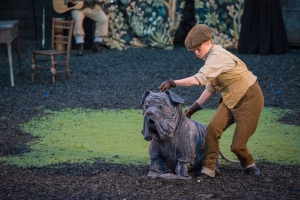
   By far one of the most standout aspects of the play is the veritable menagerie of wonderful animal puppets designed and directed by the talented Toby Olié. From the menacing dog of Mary’s uncle to the friendly robin that flits through the air and helps her to rediscover the long hidden garden – plus a whole host of other wonderful creatures in between – the rustic and charming puppet cast does not fail to delight as it is animated by actors attired in flat caps and waistcoats, appropriately christened “the Secret Gardeners”. Olié, who not only had to design puppets that could potentially withstand the very worst of the British weather, but also had to make sure that each puppet could be seen by the whole audience and was not being blocked by its puppeteer (a fair challenge in a 360̊ stage space), has succeeded in creating a truly magical and heartwarming display of puppetry.      
       DSC_5485DSC_5663
The whole cast – dressed in beautiful period costume designed by Jessica Curtis – provides a strong performance, with many of its members playing a number of different roles, as well as providing musical accompaniment on fiddle, accordion, drum and tin whistle. Actress Jessica Clark effortlessly portrays young Mary’s transformation from sour, “little crab apple” to joyous and kindhearted, little girl. Scenes featuring Yorkshire maid, Martha, (played by Kathryn Delaney) as well as actor Gareth Williams’s gruff gardener, Ben Weatherstaff, are the source of plenty of warm Northern humour. One notably striking scene, with excellent music by Sarah Travis, has characters dancing and chanting a spell to call home the far-wandering Mr Craven, as puppet animals gather excitedly around, and is undoubtedly one of the highlights of the play as a whole.
DSC_5577
   The aesthetic of the performance focuses strongly on the notion of nature’s resurgence, and the secret garden’s rejuvenation closely reflects that of the characters tending to it. Commonplace, man-made objects are whimsically transformed into natural wonders, as ladders become the trunks of trees and delicate lace parasols transform into green foliage and blooming purple flowers. By the second half, as life in the garden stirs once again, a spreading patch of grass appears in the centre of the performance space, as if from nowhere.  By the final act, even a wardrobe has burst open to reveal a dazzling array of flowers emerging from inside.
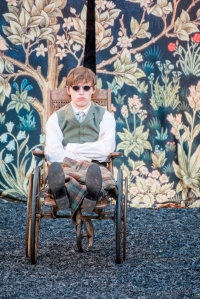
   The piece emphasises half-explored themes of prejudice within the original story, whether it concerns class, race or gender. The words of Mrs Lennox as she scolds her daughter’s “filthy native” Ayah in India, are repeated by Mary herself when she first meets her new maidservant, Martha, in Yorkshire. These obstacles are later overcome, however, as Mary goes on to befriend Martha and her animal charmer brother, Dickon. The addition into the plot of a modern-thinking, perceptive, female doctor who treats Mr Craven’s spine curvature abroad contrasts starkly against the thoroughly Victorian male doctor back at Misselthwaite Manor, whose supposed treatment of sickly, young invalid Colin Craven is laced with a sinister ulterior motive. In response to Craven’s remarks that she is a truly “remarkable woman”, she assuredly corrects him by explaining that she is, in fact, “a remarkable doctor."
DSC_5691
The Secret Garden is a fabulous adaption of a much-loved classic, that stays true to the original story’s messages of kindness and healing magic within us all, and is sure to be enjoyed by children and big children alike!
   The Grosvenor Open Air Theatre runs until 24th August, and is also currently staging Macbeth and The Comedy of Errors.

For tickets and for more information, visitwww.grosvenorparkoepnairtheatre.co.uk or call 0845 2417868


09/01/2014

CULTURE: CHARLIE CHAPLIN'S STUNNING AND MOVING SPEECH ON HUMANITY


Charlie Chaplin’s beautiful and moving speech on humanity and the fight for a free and united world, from his film The Great Dictator (1940), and with the addition of stirring music by Hans Zimmer from the film Inception (2010).
Utterly stunning. Never have his words rang more true than in these times of oppression, greed, and fear.

17/08/2013

REVIEW: CHESTER POETRY PUB TOUR

A night at the pub has a new way with words
This week sees Chester Performs make its quest to cultivate Cestrian culture a late night affair as it launches its first ever Poetry Pub Tour.

    Tim Clare, the award-winning, popular stand-up poet and presenter of the Channel 4 series How To Get A Book Deal, is our host for the evening; an engaging, hilarious and talented wordsmith, Clare was also the creator of the Poetry Takeaway which featured at the 2012 Essar Chester Literature.
    We start at The Bear and Billet, then zigzag our way through rhyme, past metaphor and up Lower Bridge Street via The Cross Keys and Ye Olde Kings Head, before finally ending up at the Marlbororough (Yep, that is spelt correctly) Arms.

    The formula is a winning one: everyone buys a drink, we sit, Tim chats to us and makes us laugh a lot, reads us one or two of his brilliant poems, we chat some more, then move on to the next pub... Sounds simple? Maybe so, but the best things always are.

    To kick things off at the Bear and Billet, Tim recites a poem he has composed about a servant locked in a room for laziness and left to starve, whose ghost is still supposedly heard sobbing to this day. Since the pub, we learn, was the birthplace of John Lennon’s grandmother, the poet cleverly inserts one or two of said Beatle’s lyrics into the verse. To counter any surfeit doom and gloom at the Cross Keys Clare reads a piece, from his first published poetry collection, about ‘Beer Ghost’ – that strange phantom that only ever seems to visit and turn your room upside down when you’ve had a heavy night out.

    Later at Ye Olde King’s Head, with a dozen of us gathered round him and with his trusty uke in hand, Tim delights us with the musical tale of one peculiar, old gent , a row boat and a quest to thwart the Oxbridge boat races, from his album of spoken and sung verses, Jesus buys me Cigarettes.
    The fact that this evening’s event was the first of its kind means that the time spent at each venue is perhaps a little more rigorously observed at first than it should be, but after a pub (and pint) or two the night happily reaches a more natural pace.

   It’s so incredibly refreshing to pass an evening with a mix of such warm and friendly faces from every age group, come together through a love of poetry to share laughs over a drink and learn about the fascinating, and often grisly, history of the city’s pubs in the process.

    Were Chester Performs to make the tour a monthly occurrence, with an ever changing list of venues and visiting poets, the night would quickly become an absolute city favourite both for locals and for curious tourists after something a little different.

   To find out more about Tim Clare and purchase some of his poetry and other writing, visit
http://www.timclarepoet.co.uk/

24/07/2013

THEATRE REVIEW: A MIDSUMMER NIGHT'S DREAM ~ Grosvenor Park Open Air Theatre

A dreamy way to spend a Midsummer's night


Though rain begins to fall with aptly theatrical timing, nothing can dampen the spirits of the audience members as they sit munching their picnics, eagerly awaiting Chester Perform’s production of A Midsummer Night’s Dream to commence at Grosvenor Park Open Air Theatre. It wouldn’t be a British Summer without a shower or two , but luckily the clouds quickly pass to make way for this intriguing interpretation of a timeless work.

In a performance that reiterates the notion of reflection and contrast, we soon learn that the actors playing mortal rulers Hippolyta and Theseus are also cast as the flighty rulers of Faery, Titania and Oberon.  Clever use of actor twins Danielle and Nichole Bird means that Puck, the nimble trickster sprite, appears to zip around the earth in the twinkle of an eye, speedily rushing off stage in one direction only to zoom past again from the other seconds later. Though the two later come to be on stage at the same time, admittedly shattering the ingenious illusion, the production’s duality motif is further highlighted by the antics of the mischievous pair.
The most striking embodiment of this counterpart imagery appears when the acting troupe of simple tradesmen first depart, lifting up a giant metal ring from around the circular stone podium in the midst of the theatre - a symbolic loosening of the girdle of reality and reason - to float in ethereal mimicry of the earthbound mortal world. Only now that this strange doorway in the air is manifest, and the deliciously atmospheric full moon gleams amid the real storm clouds above, can the Fairies enter; attired like a motley gypsy band, they bring no end of mayhem and mischief in their wake, not to mention spark a veritable explosion of carnal yearning in the mortals with which they choose to toy for a night’s sport. . . With the juice of an intoxicating flower smeared about their eyes, we see rival suitors Lysander and Demetrius snarling and writhing like hounds as they hump the earth (as well as the leg of a very bewildered Helena) in a burst of pure animalistic passion.
 The result is a riotous fight scene with a rainbow spectrum of powder paint bombs blooming in the air with Fairies devilishly providing the unwitting humans with ammunition. Whilst hilarious, it has to be said that the dismayed sense of sisterly betrayal Shakespeare penned in the quarrel between Helena and Hermia is somewhat disappointingly drowned out in the uproar.
Nevertheless, the combined efforts of director Alex Clifton and choreographer Imogen Knight ensure that the Bard’s elegant and ornate Elizabethan words are colourfully expressed in a manner that is enormously entertaining to all the family.  Spectacle is very much the order of the day and we are given it in abundance: lords and ladies chant in candlelit procession; Fairies crow a rustic lullaby on folk instruments; the humble workemens' troupe performs its play-within-a-play to the newly-weds (now seated, like the audience, with drink and picnic in hand) along with a sprightly Morris dance, at both of which the audience continually roar with laughter, clapping and stomping away to the music.
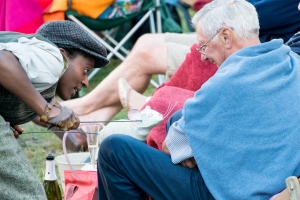
Actors and audience alike delight in the frequent interaction with the gathered onlookers: lordly Oberon smears the charmed flower’s aphrodisiacal juice upon the noses of an elderly couple and cheekily wishes them a good night, whilst Bottom runs about as an ass with a Fairy entourage to steal a swig of prosecco or a mouthful of grapes from stunned picnickers, and lovelorn Helena chases her would-be sweetheart through the seated crowd to take a perilous dive off the terrace above.
Shakespeare’s work continues to speak to us through the ages of the unifying and transcendental power of love whilst convention is well and truly turned on its head, and this production remains faithful to these themes whilst instilling it with a fresh and original vibrancy.


22/07/2013

CULTURE PRESERVATION: Help save Chester's historic Kaleyard Gate from destruction


Chester's heritage suffered enormously during the twentieth century, when much was destroyed to make way for its ring road and for modern commercial structures.

Horrifyingly, Chester Cathedral recently proposed a masterplan for the redevelopment of its surrounding area, which includes the destruction of Chester's ancient pedestrian Kaleyard Gate on Abbey Street in order to make way for car access to a Free School soon to be created in Abbey Square. Chester's walls, including the ancient pedestrian Kaleyard Gate, are a Grade I Scheduled Monument, and for the Dean and Chapter to have suggested this is utterly disgraceful and is in violation of English Heritage legislation. 

 Below is a template email to be sent to English Heritage requesting their intervention in this matter in order to preserve Chester's unique and already dwindled history. The message can be edited as you see fit, and can optionally be altered in order to send it to the Cathedral's project team director.

I'd be extremely grateful if you could find take a minute or two to either send a copy of this email to English Heritage or even write a few words of your own expressing your opposition. PLEASE, help save our history!
----------
LETTER:

To whom it may concern,

As you will be aware, Chester’s historic buildings and monuments suffered colossal blows during the twentieth century, with much of its heritage being erased in the name of “Progress”. 

It is as a concerned citizen of Chester and eager defender of history that I am writing to you. Nearly all of the city walls, including its pedestrian Kaleyard Gate (situated on Abbey St), are a Scheduled Monument with Grade I listing; however, the Dean and Chapter of Chester Cathedral have audaciously proposed the Gate’s destruction as part of a project for redevelopment that has had to be altered once already due to its infringements on heritage conservation.

Operations director for the Cathedral’s master plan, Simon Warburton, recently described the gate as nothing but a ‘hole’ in an interview for the Chester chronicle, appearing to be totally ignorant of the fact that the Kaleyard Gate has existed for almost seven and a half centuries and has, from the very beginning, been part of the history of the Cathedral, with the monks having requested its creation in order to access their vegetable garden. The tradition of the gate being locked at the 8 o’ clock curfew each evening, originally to prevent the attacks from marauding Welshmen, has also been observed since that time, and always by the Cathedral.

Incredibly, it now wishes to turn its back on all this and seeks to destroy one of the city’s ancient gateways for the benefit of those attending a Free School soon to be created in Abbey Square in partnership with the University of Chester. It is unimaginable that the Cathedral could condone destroying a piece of the city’s already dwindled heritage which is so completely bound to itself in order to shave a few minutes off the school run for a select minority dropping off its children at a school that will no doubt endure for a sum of years that is paltry in comparison to that of the Gate’s age. In light of the fact that Gorse Stacks car park is less than five minutes away, and a car park is in existence on the other side of the Kaleyard Gate in which private parking could be easily developed, it is baffling to think that the notion of bulldozing a large hole in the walls has even been considered.

It is already devastating enough to learn that the plans also include building luxury houses on the city’s sole surviving ancient green, beneath which lie the remains of the Deva Roman fortress barracks rediscovered in the 1920s; this further recklessness cannot be allowed.

I implore English Heritage to intervene and protect the Kaleyard Gate from this madness – for this proposal surely is madness – at all costs and preserve this unique portion of Chester’s illustrious history for future generations.
Yours sincerely,

[INSERT NAME]
--------------

To contact English Heritage: northwest@english-heritage.org.uk 

To contact Chester Cathedral's project team: 
amie.williams@chestercathedral.com

For further details of the Cathedral proposal: http://www.chestercathedral.com/news/cathedral-masterplan.html

For more about the facinating history of the Kaleyard Gate and surrounds visit: http://www.chesterwalls.info/kaleyard.html


19/07/2013

THEATRE REVIEW:CYRANO DE BERGERAC ~ Grosvenor Park Open Air Threatre, July 2013

Cyrano’s success as plain as the nose on his face


The Grosvenor Park Open Air Theatre has been delighting its audiences since its launch back in 2010 by champions of Cestrian culture Chester Performs. With nine critically acclaimed productions under its belt, the open air group goes to show it only improves with age as it wows us with this year’s outstanding productions of Othello,A Midsummer Night’s Dream and Cyrano de Bergerac.
    Edmund Rostund’s renowned play follows the tale of the nobleman Cyrano, chief Cadet in the French army’s Gascon company and wordsmith extraordinaire who can melt or enflame a heart by merely opening his mouth; he has nevertheless afflicted by an overly large nose. Our hero’s cousin and secret love, the fair Roxanne, is smitten by a handsome but inarticulate new Cadet and so Cyrano embarks on the heart-breaking quest to woo the lady on his friend’s behalf.
      Having previously written for the Grosvenor Park theatre, Glyn Maxwell makes a triumphant return with this striking, new adaption directed by Lucy Pitman-Wallace; no mean feat, with the writer having to tackle a the original work's forty threenamed parts – as well as a host of soldiers, courtiers, poets and more – all inhabiting five utterly different sets, from a baker’s shop to a war-zone, and somehow transform it all into twelve actors performing in one single outdoor space.

   Shuffling the play’s chronology, the nun’s from Act V are ingeniously brought forward to the opening (thus seamlessly framing the plot) as they begin to recount the tale of the soldier-bard from some fifteen years before. Before long, we see the nun’s take on the roles of many of those in the story, suddenly arming themselves and donning plumed hats as they riotously merge with other figures that enter now from all directions in sumptuous period costume, along with the titular protagonist himself played by Edward Harrison. The actor's portrayal of de Bergerac and his legendary panache is superb: sporting a stylised nose cleverly crafted from parchment covered in poetry, Harrison is charismatic, witty and collected with the most perfect theatrical timing.


   Indeed, the whole cast ought to be praised for their stellar performances, not least the nuns with their ever-changing roles; perhaps most notable amongst them being the talented twins Danielle and Nichole Bird. Many of the cast also had a chance to showcase their musical accomplishments: during a rousing and rustic Gascon anthem played to lighten the lift hearts before battle; Katherine Toy’s pleasing accordion interludes between and even during scenes; the emotive and truly haunting a capella chanting of what seemed to be a Latin mass during the dual between Cyrano and one hundred men, skilfully choreographed in slow motion by Sue Nash.

   With actors scaling the seating and livelily interacting with audience members happily picnicking mere feet away, Cyrano de Bergerac is an outstanding performance – at times brimming with humour, at others poignant and heart-rending – that is sure to thrill this summer’s theatre goers.

 For more information on this or any other performance, visit: http://www.grosvenorparkopenairtheatre.co.uk/


Related Posts Plugin for WordPress, Blogger...